In diagnostic X-ray imaging, the difference between a “good” image and a diagnostic image often comes down to one thing: contrast.
Picture a busy imaging room. A technologist reviews a chest or abdominal image that looks acceptable at first glance, but subtle details are harder to see. Edges feel soft. Contrast feels washed out. The exposure was correct, the detector is modern, and the system performed as expected. What went wrong?
More often than not, the culprit is scatter radiation, an invisible but relentless byproduct of X-rays passing through the patient.
As digital radiography continues to advance, many imaging teams are now faced with a practical decision: should scatter be managed with a hardware (physical) X-ray grid or with virtual grid software? While both approaches promise better-looking images, they are built on fundamentally different principles, and those differences directly impact image quality, dose efficiency, and diagnostic confidence.
Understanding how each method works, and what it can and cannot do, is essential for anyone responsible for image quality at the point of care.
What Is Scatter Radiation and Why Is It a Problem?
When X-rays pass through a patient, a portion of the radiation is deflected from its original path. This deflected radiation, known as scatter, reaches the detector at random angles.
Scatter is problematic because it:
- Adds non-image-forming noise
- Reduces image contrast
- Obscures fine anatomical detail
- Complicates visualization in thicker or denser anatomy
The larger the anatomy and field of view, the more scatter is produced, making scatter management essential in general radiography, trauma imaging, and veterinary applications.
Hardware Grid (HW Grid): Physically Removing the Problem
A hardware X-ray grid is a physical device placed between the patient and the detector. It consists of thin, precisely aligned lead strips separated by radiolucent material.
How a Hardware Grid Works
- Primary X-rays travel in straight lines and pass through the grid
- Scatter radiation travels at oblique angles
- Lead strips physically absorb scatter before it reaches the detector
Key Benefits of Hardware Grids
- True scatter removal, not estimation
- Maximizes signal-to-noise ratio (SNR)
- Delivers superior contrast and edge definition
- Produces images based almost entirely on primary radiation
In short, a hardware grid eliminates the source of contrast degradation at the physics level, before the image is even created.
Virtual Grid (VG): Suppressing the Appearance of Scatter
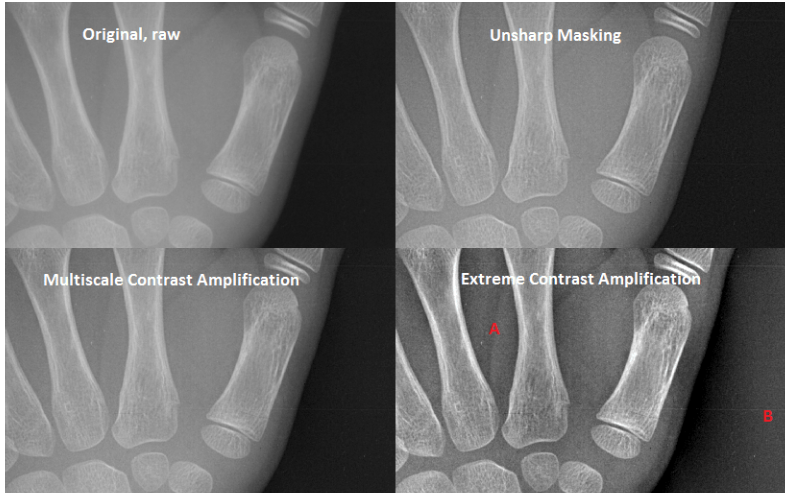
A virtual grid is not a grid at all, it is a software algorithm applied after the image has already been acquired.
How a Virtual Grid Works
- Analyzes the raw digital image
- Attempts to model the scatter component mathematically
- Applies filtering (kernel-based processing) to reduce low-frequency noise
- Enhances contrast and smooths granularity
The Core Limitation
Scatter radiation is random and unpredictable. Once it has reached the detector and mixed with primary signal data, it cannot be truly removed, only approximated.
As a result, virtual grids function as contrast-enhancement tools, not true scatter-removal systems.
Hardware Grid vs. Virtual Grid: The Core Difference
The essential distinction is simple:
- Hardware Grid:
A physical filter that removes scatter radiation before image formation - Virtual Grid:
A digital post-processing tool that suppresses the visual effects of scatter after acquisition
In Practical Terms
- Hardware grids solve the problem
- Virtual grids mask the symptoms
Both may improve image appearance, but they are not equivalent in diagnostic integrity.
Why Physical X-Ray Grids Still Matter in Modern Radiography?
Despite advances in software, physics has not changed. Scatter is still generated the moment X-rays interact with tissue.
A physical grid remains indispensable when:
- Imaging large or thick anatomy
- High diagnostic confidence is required
- Fine contrast resolution matters
- Dose efficiency and repeat reduction are priorities
Hardware grids ensure that what reaches the detector is clean, image-forming radiation, preserving the full potential of high-resolution digital detectors.
The JPI Perspective: Image Quality Starts Before the Software
At JPI Healthcare Solutions, image quality is not treated as a post-processing problem, it is engineered at the source.
With decades of leadership in X-ray grid design and image-quality research, JPI continues to emphasize:
- True scatter rejection
- Physics-driven image optimization
- Hardware solutions that enhance every downstream technology
Software has its place, but no algorithm can replace radiation that was never filtered out.
Final Takeaway
Virtual grids can enhance images. Hardware grids protect diagnostic truth.
If image quality, contrast integrity, and clinical confidence matter, the difference between removal and suppression is not subtle, it’s foundational.