What constitutes a good scintillator or an appropriate pixel pitch for a specific image? Understanding these technical terms often requires a solid background in imaging physics. Additionally, specifications documents from different manufacturers may present this information in varying formats, making it difficult to compare panels directly. The multitude of features—ranging from image processing capabilities to system integration—can overwhelm buyers, obscuring the most relevant information needed for their specific applications.
Without proper context, it can be hard to grasp the real-world implications of specifications like resolution, pixel pitch, or MTF. These factors directly influence image quality and diagnostic capabilities. Having a clear understanding of these specs helps ensure the chosen panel meets the specific clinical needs and performs optimally in real-world settings.
Let’s dive into how to choose the right flat panel for your customers.
Scintillator: The Core of High-Quality Image Conversion
The scintillator is one of the most important components of a flat panel detector because it converts X-rays into visible light, which the detector then converts into a digital image. This part can have a significant impact on the image quality and performance of the panel.
There are two types of scintillators: Cesium Iodide (CsI) and Gadolinium Oxysulfide (GOS). CsI is typically preferred for veterinary and medical diagnostics because it provides higher image quality with greater spatial resolution and requires a lower radiation dose. On the other hand, GOS panels offer lower spatial resolution compared to CsI but are more affordable. If you need to make a decision on this, the preferred choice would almost always be Cesium Iodide (CsI) panels. The difference in price between the two technologies has become much lower over the last 5 years than it was in the past, and the performance advantages of CsI are huge.
You may come across some scintillators referred to as “Direct Deposit.” Scintillators, made from crystals, vary in how these crystals are attached to the underlying detector. In standard scintillators that are not labeled as Direct Deposit, the crystals are grown on a plastic film, which is then glued onto the detector. In contrast, Direct Deposit scintillators are created by growing the crystals directly on the detector, eliminating the need for plastic or glue.
Direct Deposit scintillators offer superior performance in every aspect. Since the crystals are in direct contact with the detector without any intermediate materials to absorb or scatter light, they produce sharper images and require lower x-ray exposure to achieve the same results.
Software: The Way You Improve Your Workflow and Diagnosis Accuracy
Software is the key to enhance usability and functionality. A user-friendly interface enables operators of all skill levels to navigate the system with ease. Essential image processing tools, such as contrast adjustment and noise reduction, are vital for producing high-quality images. Furthermore, real-time imaging capabilities and customizable settings allow for immediate diagnoses and tailored imaging protocols that cater to diverse patient needs. It’s also important to ensure that the software integrates seamlessly with existing systems, such as Picture Archiving and Communication Systems (PACS), Practice Management Systems (PMS) and Electronic Health Records (EHR), to improve workflow and data management.
However, even the best software is ineffective without reliable technical support. Insufficient assistance can lead to prolonged downtimes, so it’s essential to thoroughly evaluate the level of service offered with the software. Be cautious of software that features complex navigation or cluttered interfaces, as these can frustrate users and increase the likelihood of errors. Limited image processing options can hinder your ability to achieve the high-quality images necessary for accurate diagnoses. Additionally, avoid solutions with known compatibility issues with existing systems, as these can disrupt workflows. Lastly, be wary of high licensing fees, support costs or hidden costs, as they can strain the budget of customers and make them very unhappy in the future.
Why Pixels Are Important
Pixel size defines the maximum image resolution achievable by the panel. Each pixel acts as a small detector, capturing X-rays and converting them into electrical signals to create a digital image. Smaller pixel sizes and higher pixel density result in greater spatial resolution, producing sharper and more detailed images. This is particularly crucial in specialized diagnostic imaging, such as imaging hands or small animals, where high-resolution images are essential for accurate evaluations.
When choosing a panel, remember that high resolution may not be necessary for every application. There are trade-offs for that higher resolution. High-resolution panels typically require more X-ray exposure, which can increase radiation levels. Ensure that the panel’s resolution is suitable for your imaging needs, as smaller pixels demand higher X-ray doses, and select the right technology carefully to maximize your investment’s value.
Panels are Flexible?
The term “flexible panel” is often used, but it doesn’t mean that the panel can actually be bent. Instead, it refers to the fact that the electronics are built on a plastic substrate rather than glass. This design makes the panel lighter and more durable, reducing the likelihood of it breaking if dropped. However, the term “flexible” can be misleading, as it implies physical flexibility that isn’t present. A more accurate description is “glassless” rather than “flexible,” as this better conveys the nature of the panel’s construction without causing confusion.
Using glassless panels offers practical advantages such as increased portability and durability, which is especially useful in environments where equipment is frequently moved or at risk of being dropped.
Additional Terms for Technical Precision
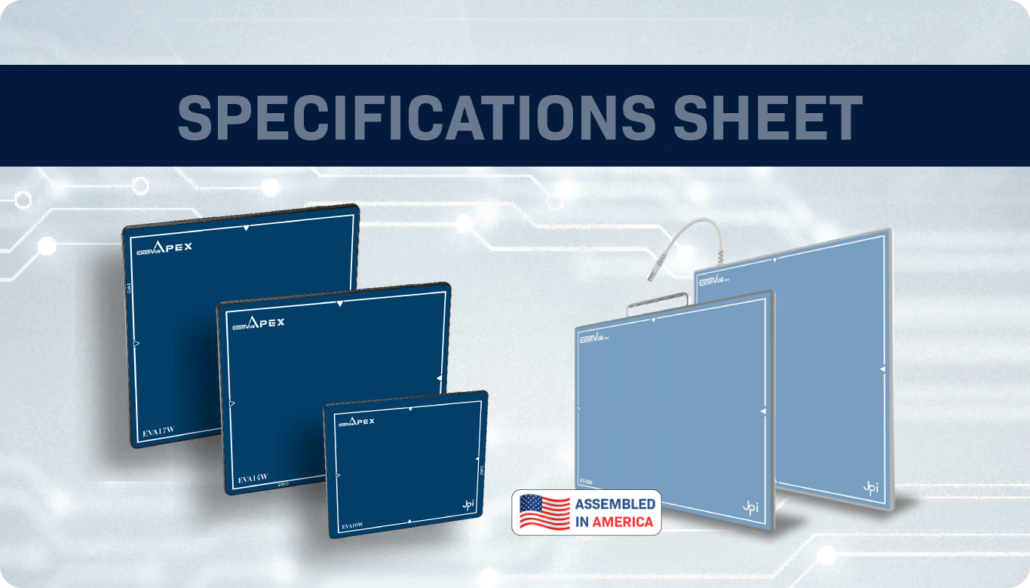
Detector specification sheets can feel overwhelming with all the technical details, but they’re a great tool for understanding what a panel can do and how it might fit your needs. They highlight key features and applications, helping you make a more confident and informed decision.
MTF (Modulation Transfer Function) describes how accurately the system can reproduce different levels of detail from the object being imaged to the final image. A higher MTF value indicates better image quality, as the detector is more effective at preserving fine details and contrast.
Another key term to know is DQE (Detective Quantum Efficiency), which reflects how effectively a detector converts X-ray signals into a clear image. For example, a detector with a DQE of 70% is more efficient than one with a DQE of 50%, allowing it to deliver better image quality with the same or even lower X-ray dose. However, since image quality depends on many factors, DQE alone isn’t enough to directly compare detectors from different manufacturers or even between models.
Finally, the fill factor is the portion of the panel that actively absorbs X-rays. Flat panel detectors contain both pixels and connecting wires; a higher fill factor means a greater proportion of the panel is dedicated to X-ray absorption, which can improve image quality and reduce the needed x-ray to get an image.
Conclusion
The most critical factor in choosing a flat panel detector is understanding the specific needs of your practice. Ensure comparisons are consistent, focusing on equivalent specifications. Panels rely on X-ray exposure to produce diagnostic images, for this reason, the goal is not simply to select the highest specifications but to provide an efficient, high-quality product that meets the requirements for the specific type of imaging performed while minimizing X-ray exposure.